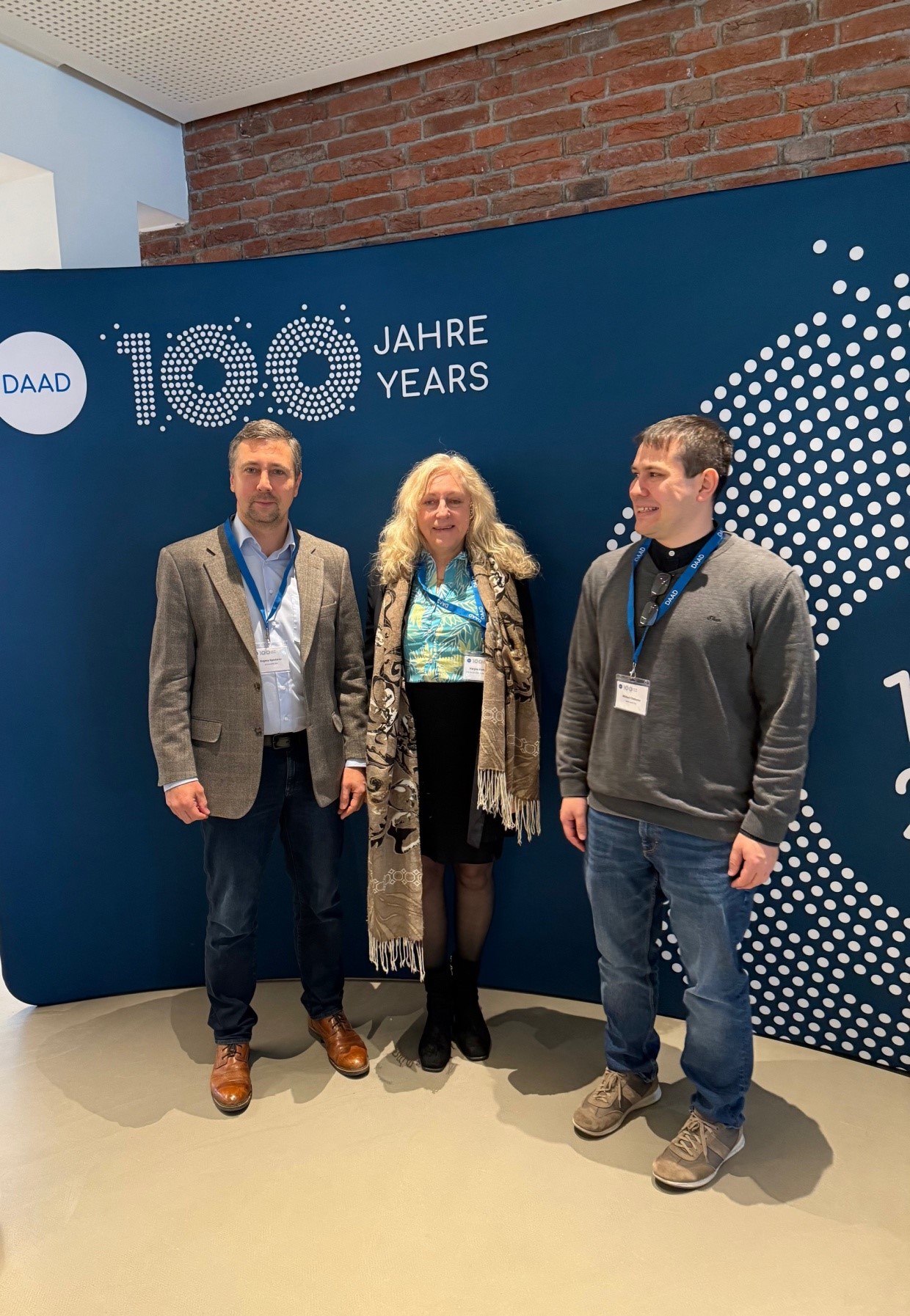
On December 4–6, the DAAD conference took place in Berlin.
This conference was dedicated to the 100th anniversary of DAAD and also had important political significance. Over the years of DAAD's existence, Ukrainian higher education institutions participating in joint projects with German universities have demonstrated a high level of professionalism, and joint projects with German universities have yielded significant results. This was emphasized in the first part of the conference. In this part, representatives of the educational sphere from Ukraine and Germany, as well as the Consul of Ukraine, spoke. Representatives from Germany clearly demonstrated their commitment to supporting Ukraine.
Dorothee Bär (Federal Minister for Research, Technology and Space) emphasized the impressive resilience of Ukrainian science even during the war.
After the official part, posters of joint projects were presented.
Representatives of the respective higher education institutions were located next to each poster.
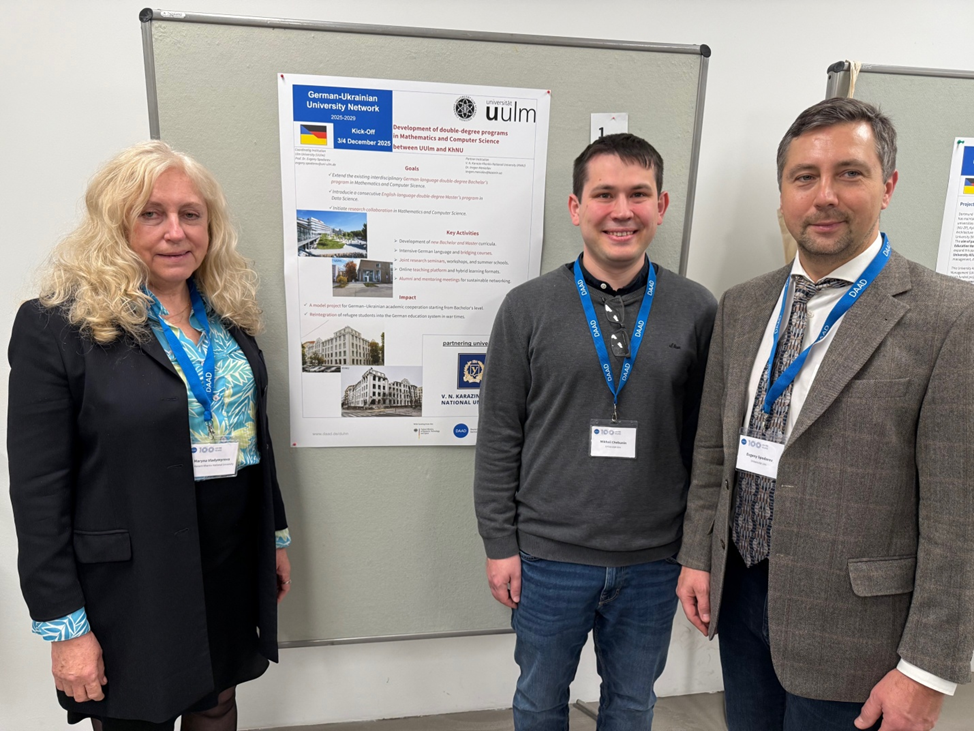
Two representatives from Ulm University – Yevhenii Spodaiev and Mykhailo Chebunin, as well as one representative from V. N. Karazin Kharkiv National University – Maryna Vladymyrova, were present from our project. In total, 5 projects were presented from our university. Kharkiv – where there are daily shellings, where there is no possibility for students to study offline – had the largest number of projects! This format is very successful, as it allows not only to learn about the project but also to ask questions, share one's own experience, and establish new contacts that open up additional opportunities for further development.
Our project aroused keen interest among many representatives.
First and foremost, this is due to the fact that the project is not in its initial stage but is already being successfully implemented. DAAD's support has made it possible not only to improve the work on creating double degree programs between the Faculty of Mathematics at Ulm University and the Faculty of Mathematics and Informatics at V. N. Karazin Kharkiv National University but also to expand cooperation opportunities through the development and implementation of a master's double degree program.
At the end of the day, the conference organizers invited all participants to a friendly dinner. This created another opportunity for informal communication among representatives of higher education institutions.
On the second day, sections were working. There were three of us from our project, and we attended three sections, actively participating in them. The sections addressed problems related to education, the organization of the educational process, the integration of Ukrainian education into the European community, and many other issues. These were extremely important topics. Even if not all of them can be resolved at the DAAD level, they were voiced and brought to the attention of both public and educational organizations, as well as representatives of political circles.
At the same time, concrete solutions for many less global but practically important problems were proposed by those who had already walked this path. Interaction, mutual support, the opportunity to hear about others' problems, share one's own experience, expand one's own capabilities, and generate new ideas – all of this was largely realized precisely during this conference.
And, of course, it was extremely important to see the support from our German colleagues, to feel their interest in the projects and joint work. In such a difficult time for Ukraine, this has special value. These are not just words of support – these are real actions and concrete work that demonstrate that Germany believes that Ukraine will definitely stand strong, will not lose its creative potential, and Ukrainian education will continue to develop and improve thanks to support and opportunities for integration into the European community.