
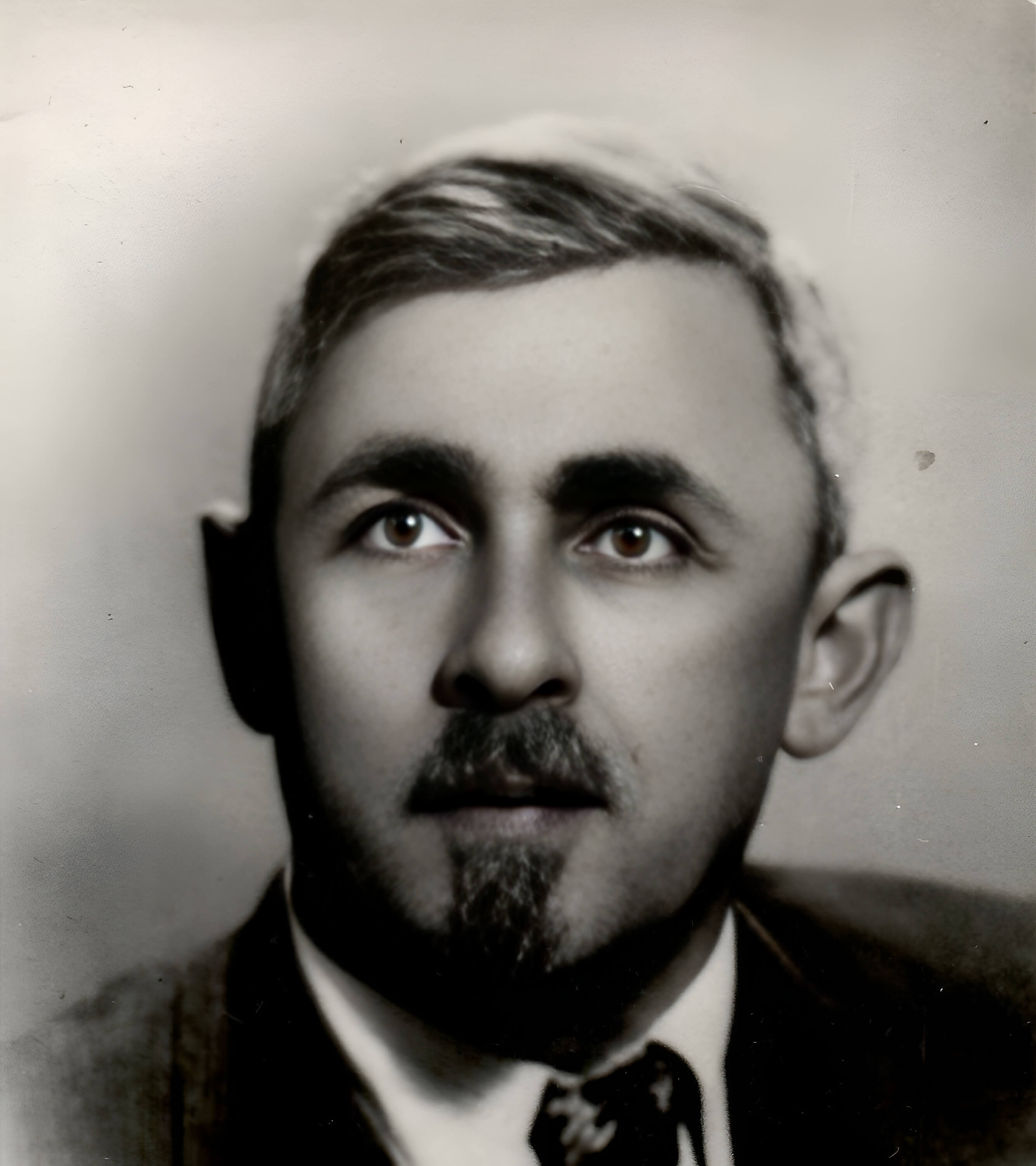
 On March 19, 2026, the Anniversary Session of the General Meeting of the Department of Mathematics of the National Academy of Sciences of Ukraine took place, organized jointly with the Kharkiv Mathematical Society. The event was dedicated to the 125th anniversary of the birth of Naum Ilyich Akhiezer, an outstanding scientist, corresponding member of the Academy of Sciences of the Ukrainian SSR (now – NAS of Ukraine) and one of the founders of the Kharkiv Mathematical School. We tell how it all was and publish exclusive photos that have never been published before.
The solemn session of the General Meeting was opened by the Academician-Secretary of the Department of Mathematics of the National Academy of Sciences of Ukraine, Academician of the National Academy of Sciences of Ukraine Oleksandr Mykolaiovych Tymokha. In his opening speech, he emphasized the exceptional role of Naum Ilyich Akhiezer as an outstanding scientist and organizer of science. He stressed that Naum Ilyich laid a strong foundation for several scientific schools. The presence of almost a hundred leading scientists from different parts of the world at the meeting was the best evidence of the scientist's influence and the relevance of his works, which remain a source of inspiration for the mathematical community even today.
Among the participants of the event were members of the Department of Mathematics of the National Academy of Sciences of Ukraine, members of the Kharkiv Mathematical Society, scientists from the USA, Austria, Norway, France, Israel.
The first to be invited to speak was the head of the Kharkiv Mathematical Society, chief researcher of the Department of Differential Equations and Geometry of the B.I. Verkin Institute for Low Temperature Physics and Engineering (ILTPE) of the National Academy of Sciences of Ukraine (Kharkiv), Academician of the National Academy of Sciences of Ukraine Yevhen Yakovych Khruslov. In his report, Yevhen Yakovych thoroughly analyzed the life and creative path of Naum Akhiezer, highlighting his formation as a world-class scientist, one of the founders of the Kharkiv mathematical school, and an outstanding organizer of science:
«On March 6, 1901, Naum Ilyich Akhiezer, an outstanding Ukrainian mathematician, Doctor of Physical and Mathematical Sciences, Professor, Corresponding Member of the Academy of Sciences of the Ukrainian SSR, and one of the founders of the famous Kharkiv Mathematical School, was born.
Naum Ilyich's scientific legacy covers fundamental branches of mathematics: approximation theory, theory of entire functions, the moment problem, as well as the theory of differential and integral operators. His research style was distinguished by a harmonious combination of classical approaches to the theory of functions of a complex variable and functional analysis. This allowed N.I. Akhiezer to solve a number of complex classical problems, including those concerning polynomials that deviate least from zero on zero on a system of intervals, to find the best constant in Jackson's theorem, and to investigate weighted approximation. In the early 1960s, N.I. Akhiezer, while studying the inverse problem of spectral analysis for a finite-zone Schrödinger operator, introduced a special class of functions. Over the past fifty years, they have played a key role in the theory of nonlinear integrable equations and are called Baker–Akhiezer functions.
A significant contribution of the scientist was an effective method for solving inverse problems of spectral analysis. Subsequently, this method found brilliant application in finding explicit solutions to a number of nonlinear equations of mathematical physics. The methods he developed for studying the trigonometric moment problem and the properties of orthogonal polynomials had practical application in aerodynamics and the integration of nonlinear differential equations.
N.I. Akhiezer's creative path became an example of combining profound science with extensive educational activities. For over forty years, he taught at Kharkiv State University, where from 1933 to 1950 he headed the Research Institute of Mathematics and Mechanics. His activities were also closely related to the polytechnic and aviation institutes of Kharkiv. Naum Ilyich formed an authoritative scientific school, having trained over 20 candidates of sciences, and was one of the founders of the famous Physics and Mathematics Lyceum No. 27.
In 1934, he was elected a corresponding member of the All-Ukrainian Academy of Sciences [as the National Academy of Sciences of Ukraine was then called], and the degree of Doctor of Physical and Mathematical Sciences was awarded without defending a dissertation – for the totality of exceptional scientific merits.
In the post-war years, Naum Ilyich managed to gather a galaxy of outstanding mathematicians in Kharkiv – Izrail Markovich Glazman, Borys Yakovych Levin, Volodymyr Oleksandrovych Marchenko, Oleksandr Yakovych Povzner, Oleksiy Vasylyovych Pogorelov, who, together with their students, determined the vector of development of mathematical science for decades. In the early 1960s
N.I. Akhiezer joined the creation of mathematical departments of the B. Verkin Institute for Low Temperature Physics and Engineering of the National Academy of Sciences of Ukraine, where he headed the department of function theory from 1961–1963.
The mathematician's scientific work includes over 150 papers, among which are 10 fundamental monographs. Nine of them have gained worldwide recognition and have been translated into many languages. In 1949, for his outstanding scientific work, the scientist was awarded the P.L. Chebyshev Prize.
Outstanding services to the state and the world community ensured Naum Akhiezer undeniable authority. Today, a Foundation named after him operates in Kharkiv, continuing the scientist's work by supporting talented youth – the future of Ukrainian mathematical science.».
Professor at the Institute of Analysis, Johannes Kepler University Linz (Austria) Petro Yuditsky delivered a scientific report «Constructive Function Theory in Operator Theory and Approximation» (“Constructive Function Theory in Operator Theory and Approximation”).
He noted that Sergei Bernstein considered constructive function theory as a basis for qualitative research and computation of solutions to natural problems of analysis. Naum Akhiezer, developing the ideas of his teacher, enriched this direction with the apparatus of geometric function theory of a complex variable and the theory of Riemann surfaces. For an initial acquaintance with the ideas of Naum Ilyich, §52 and §53 of his famous monograph «Elements of the Theory of Elliptic Functions» are recommended, which are dedicated to polynomials that deviate least from zero, and orthogonal polynomials on two intervals.
Today, Akhiezer's research on orthogonal polynomials on a finite system of intervals is viewed through the prism of Christian Remling's fundamental result on reflectionless Jacobi matrices. The development of Naum Ilyich's ideas led to a parametric description of reflectionless Jacobi matrices with spectra on Cantor sets of positive length, which, in turn, made it possible to solve the long-standing problems of Kotani–Last and Deift. Based on Akhiezer's methods, we analyze:
- the asymptotics of Chebyshev polynomials on Cantor sets of positive length;
- the complex version of the classical Chebyshev problem (after Bernstein);
- the best polynomial approximations of the function sgn(x) on two intervals.
Akhiezer himself motivated his research by the desire to expand the classical results of Sergei Bernstein and Gabor Szegő. He put forward the hypothesis that the measure of the orthogonality set, where the weight is zero, is zero. His works made it possible to include cases where the weight vanishes on entire intervals into the modern general scientific context.
About «Baker–Akhiezer Functions and Nonlinear Equations» reported, Head of the Department of Differential Equations and Geometry of B. Verkin Institute for Low Temperature Physics and Engineering of the National Academy of Sciences of Ukraine, Corresponding Member of the National Academy of Sciences of Ukraine Dmytro Heorhiyovych Shepelskyi. The report emphasized N.I. Akhiezer's decisive contribution to the establishment of the theory of finite-zone integration and highlighted the role of the functional objects he introduced in the theory of integrable systems. In particular, the speaker considered the Riemann–Hilbert problem method as a modern development of an analytical approach that allows for effectively constructing and analyzing solutions to a wide class of problems in modern mathematical physics.
A particularly interesting part of the meeting was the recollections of participants whose life and professional paths intersected with Naum Illich's figure. Those present shared stories about the scientist's influence on their development, recalling his sincere readiness to help in difficult times. The speeches of colleagues and students once again confirmed what an outstanding scientist Naum Illich was and how often his support became a decisive factor in the lives of many mathematicians.

Corresponding Member of the National Academy of Sciences of Ukraine Volodymyr Drinfel'd
The memoir part of the session was opened by Corresponding Member of the National Academy of Sciences of Ukraine Volodymyr Gershonovych Drinfel'd, laureate of many prestigious international mathematical awards, the first Ukrainian mathematician awarded the Fields Medal. He recalled the history of the name «Baker–Akhiezer functions»:
«I was studying in Moscow then, was a postgraduate student, and attended Krichever's and Novikov's reports. Krichever's report on his work played an extremely important role in my scientific life.
What do I remember from those times? At the report Krichever gave in 1975, this object was simply called «Akhiezer's function.» Baker's surname [Henry Frederick Baker] was not mentioned then for a very simple reason: his works were forgotten at that time, and Naum Illich, apparently, did not know about them.
I also remember this story. Novikov and Krichever were then working on the description of pairs of commuting ordinary differential operators – an aspect that interested me the most. This problem interested them in connection with applications to nonlinear differential equations, although it is self-contained. Solving it, they (or one of them) invented something similar to Akhiezer's function, not yet knowing about Naum Illich's work.
As Novikov recounted, he later went to Kharkiv and gave a report there on his work. And it was there that the Kharkiv residents – and perhaps Naum Illich himself, who was still alive then – noted that this was the same function that Akhiezer had invented back in 1961.
This is what I remember from the words of Serhiy Novikov and Ihor Krichever, who, unfortunately, are no longer with us. Perhaps someone present knows this story from another perspective; I know it from the «Moscow side,» from recollections and reports.
It is clear that both Baker and Akhiezer created these theories irrespective of nonlinear differential equations, because the theory of integrable systems in its modern form emerged only in the late sixties.».

Tatyana Akhiezer
Further memories were shared by Tatyana Oleksandrivna Akhiezer –Naum Illich's granddaughter:
«My father, Naum Illich's elder son Oleksandr, was born in Kyiv in 1928. Ten years later, my grandfather's first wife – my grandmother Zoya Lvivna – passed away. I want to show three pre-war photographs that have never been published before.
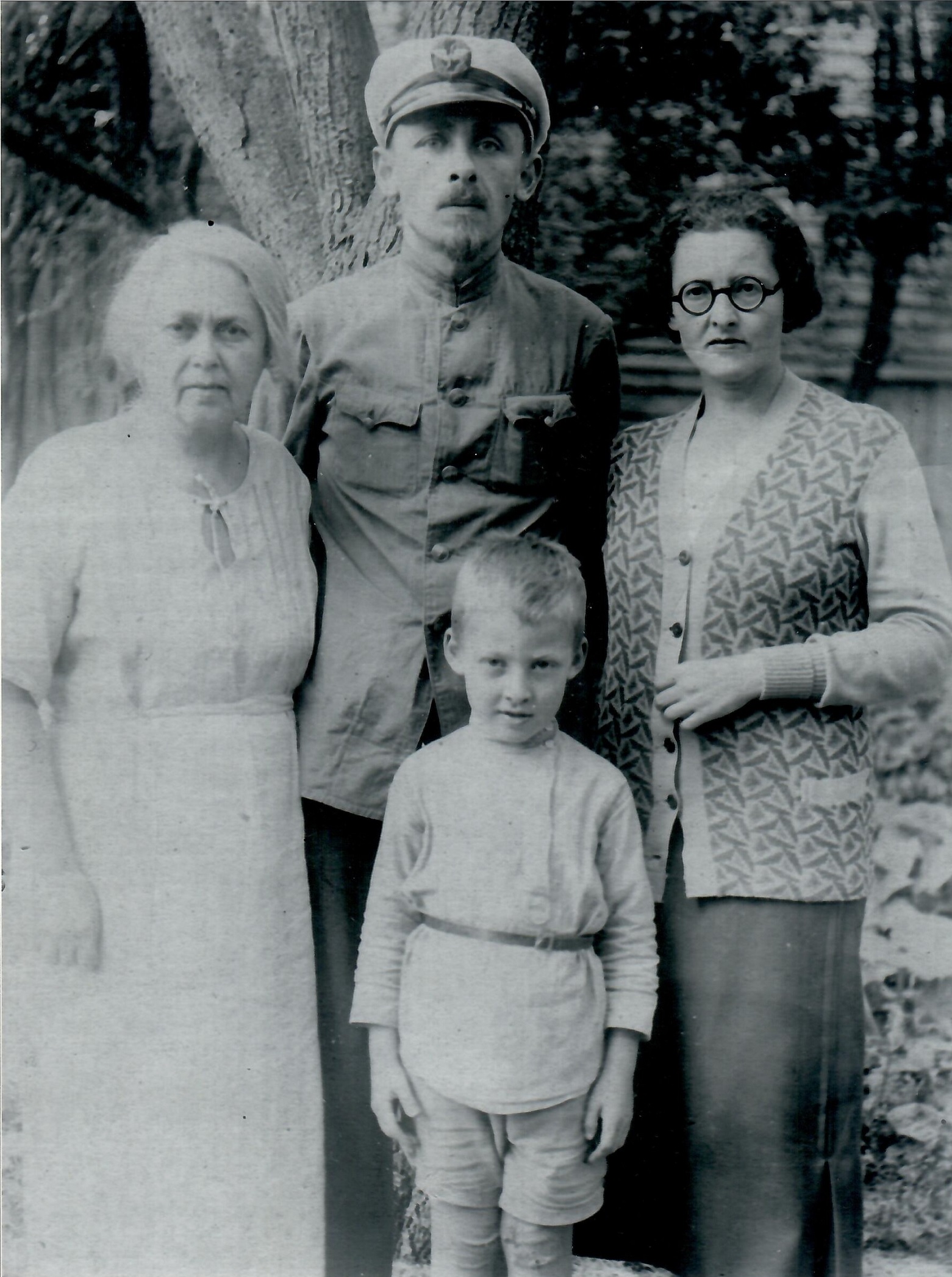
This picture shows Naum Illich, his wife Zoya Lvivna, mother Nataliya Hryhorivna, and son Oleksandr.
My father recalled: when our family moved from Kyiv to Kharkiv in 1933, an entire course of the aviation institute came to the train station to see Naum Illich off. In one of the pictures from that time, he is even captured wearing an aviation cap.
In his memoirs, my father, Oleksandr Naumovych, described the family's journey from the beginning of the evacuation in September 1941 to their return to Kharkiv in 1947. Also, among his papers, an interesting manuscript has been preserved – the memoirs of Oleksandr Illich, Naum Illich's brother, about the pre-war period. Everyone interested can read these texts.
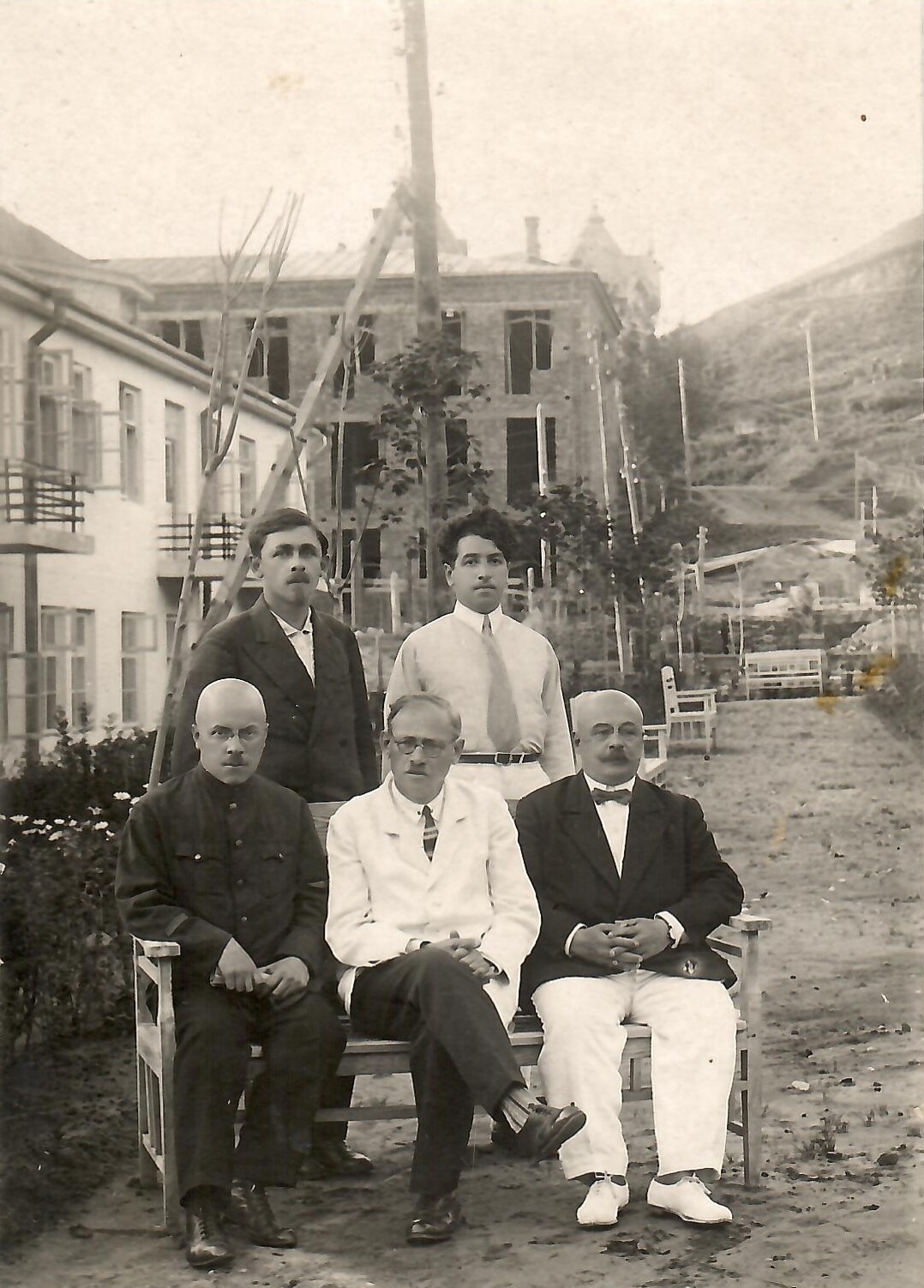
In other pictures, you see his early years: Naum Illich in Belarus, in Cherykiv. In the center is his father, zemstvo doctor Illia Oleksandrovych.

Young Naum Illich with his parents: in front – Illia Oleksandrovych and Nataliya Hryhorivna, on the left – younger brother Shurochka (Oleksandr).
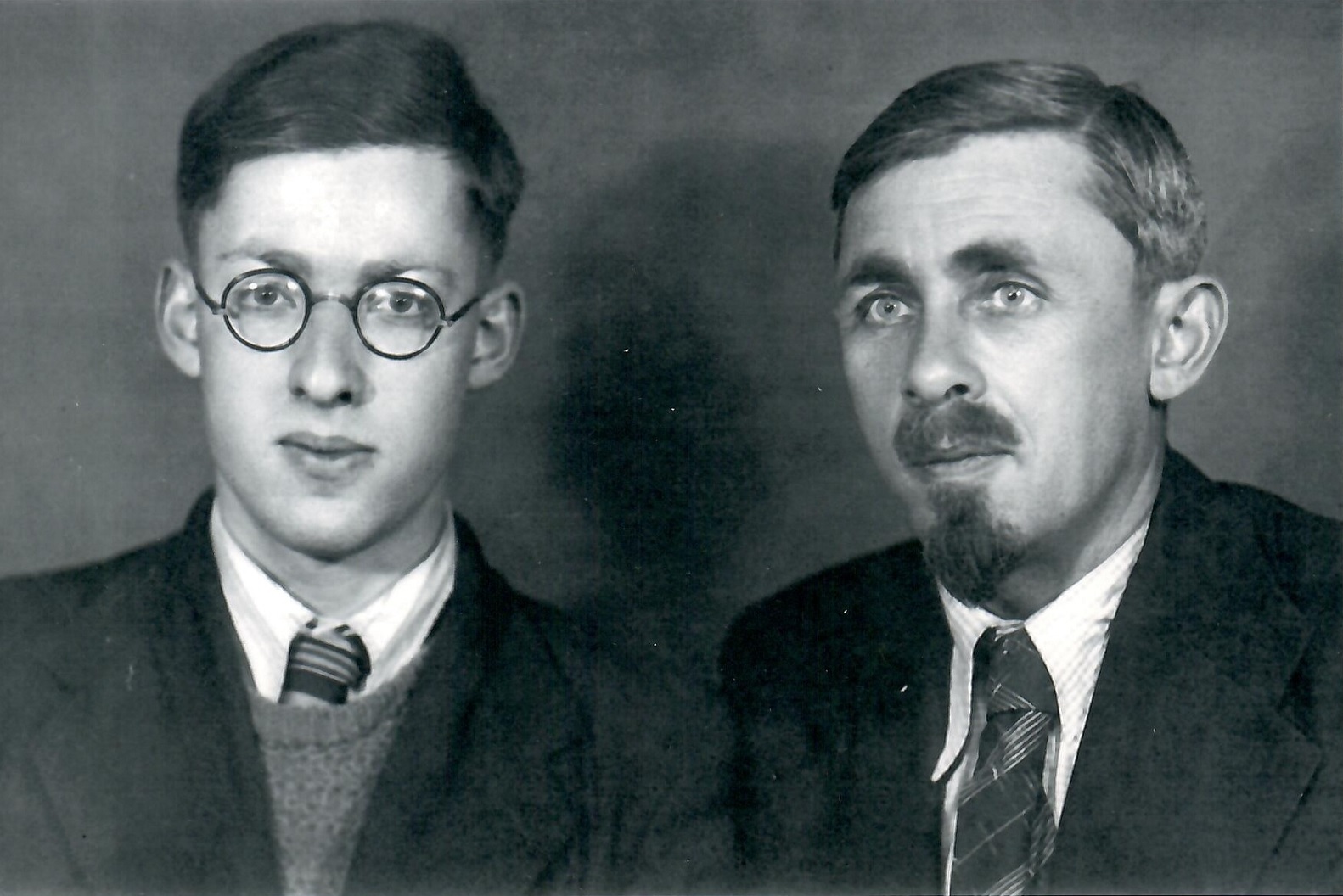
Here is a photo of the father with his elder son Alyk (Oleksandr).
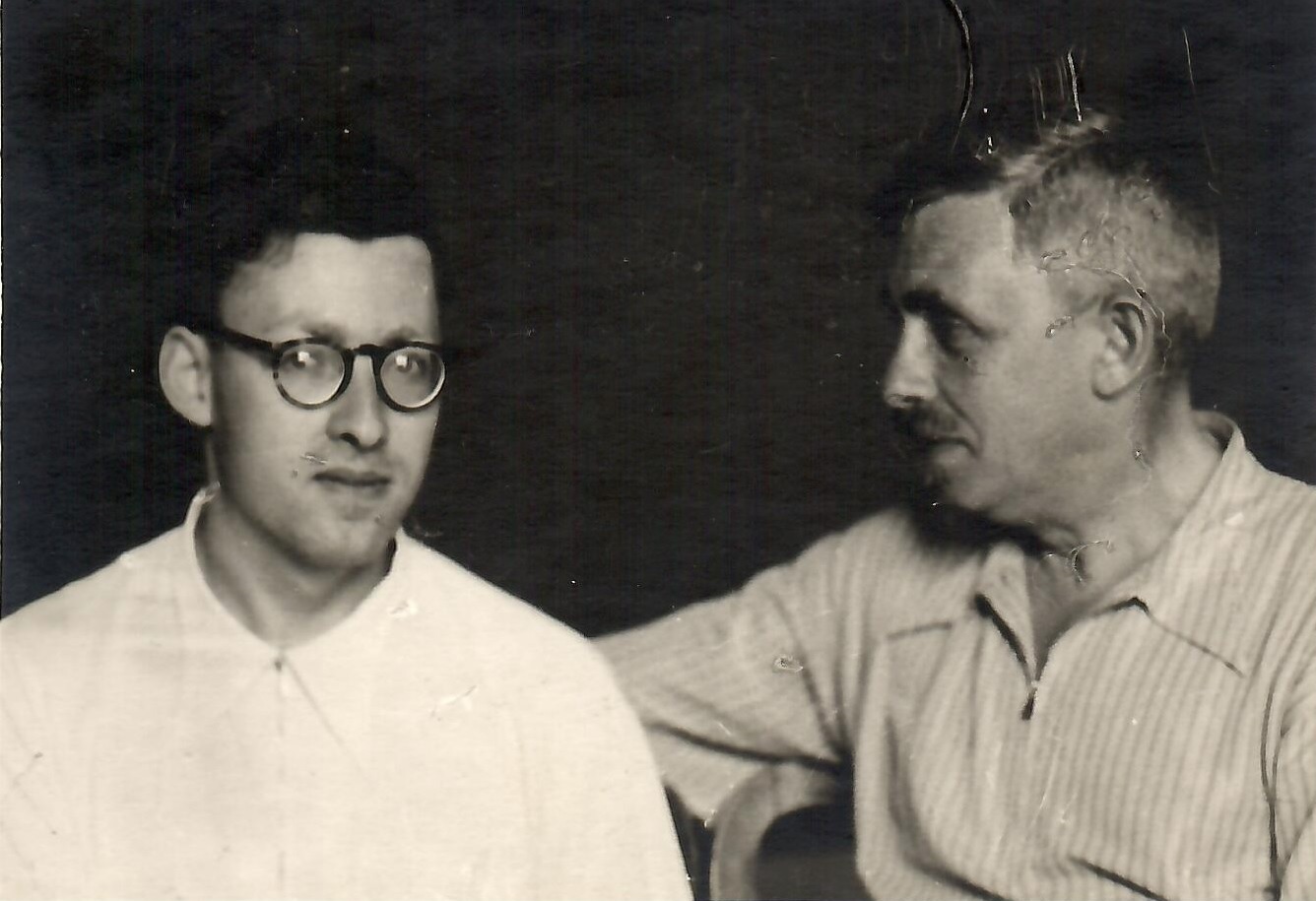
This is a later photo of the father with his elder son Alyk.
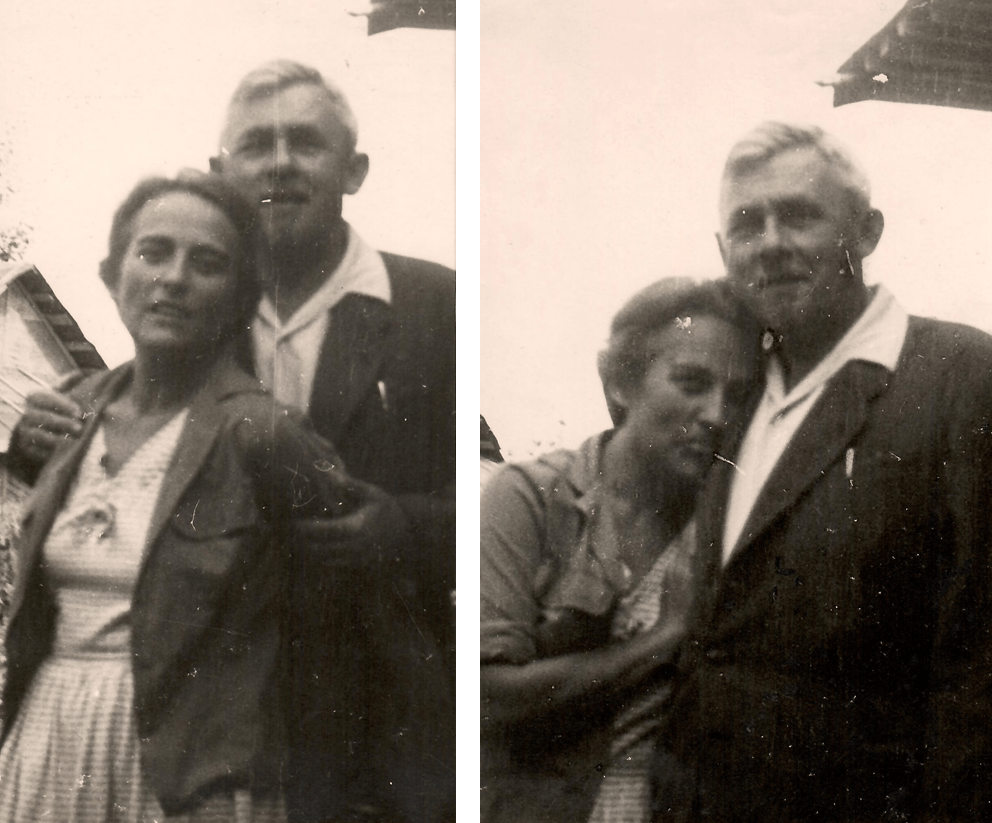
With his second wife – Halyna Vasylivna.
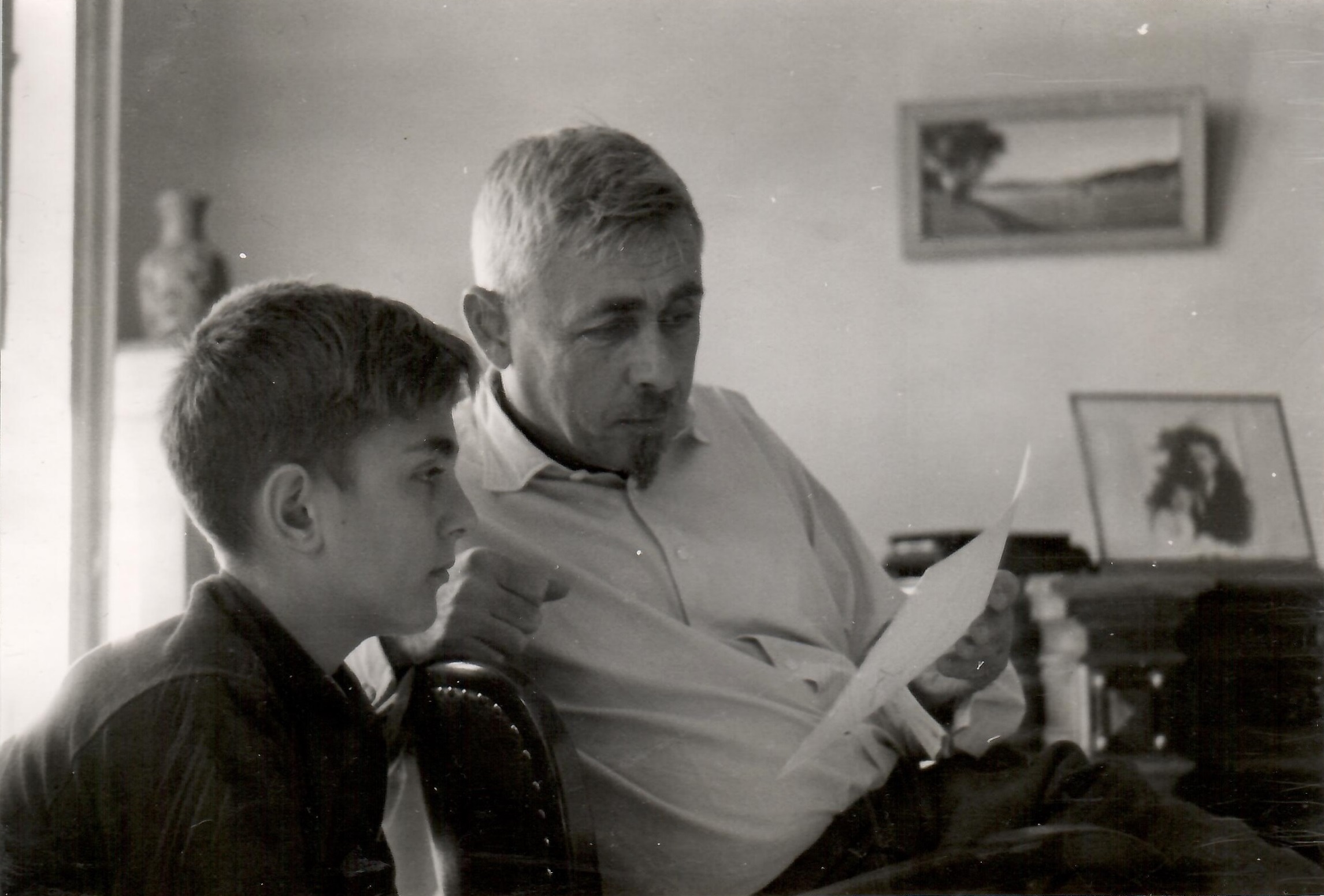
Naum Illich with his younger son Dmytro.
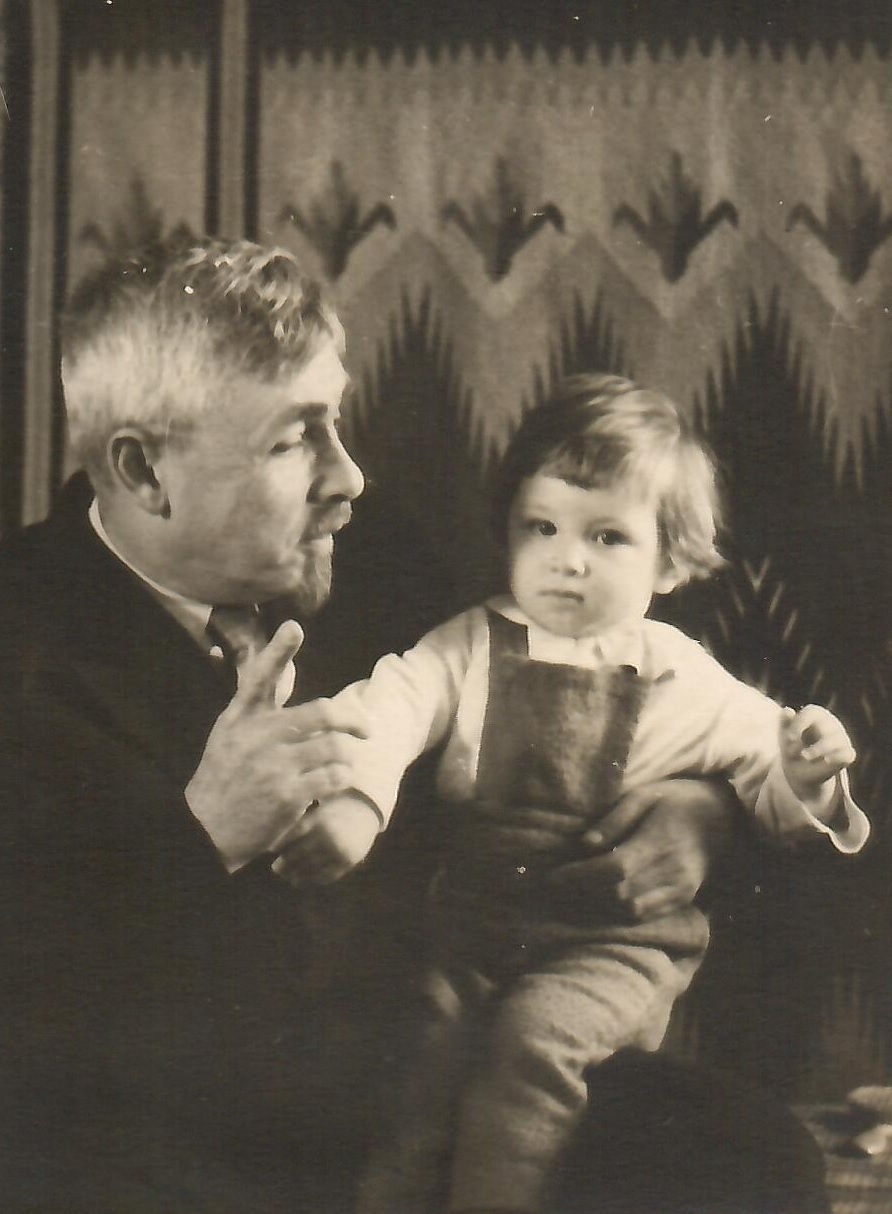
With his granddaughter Tatyana.
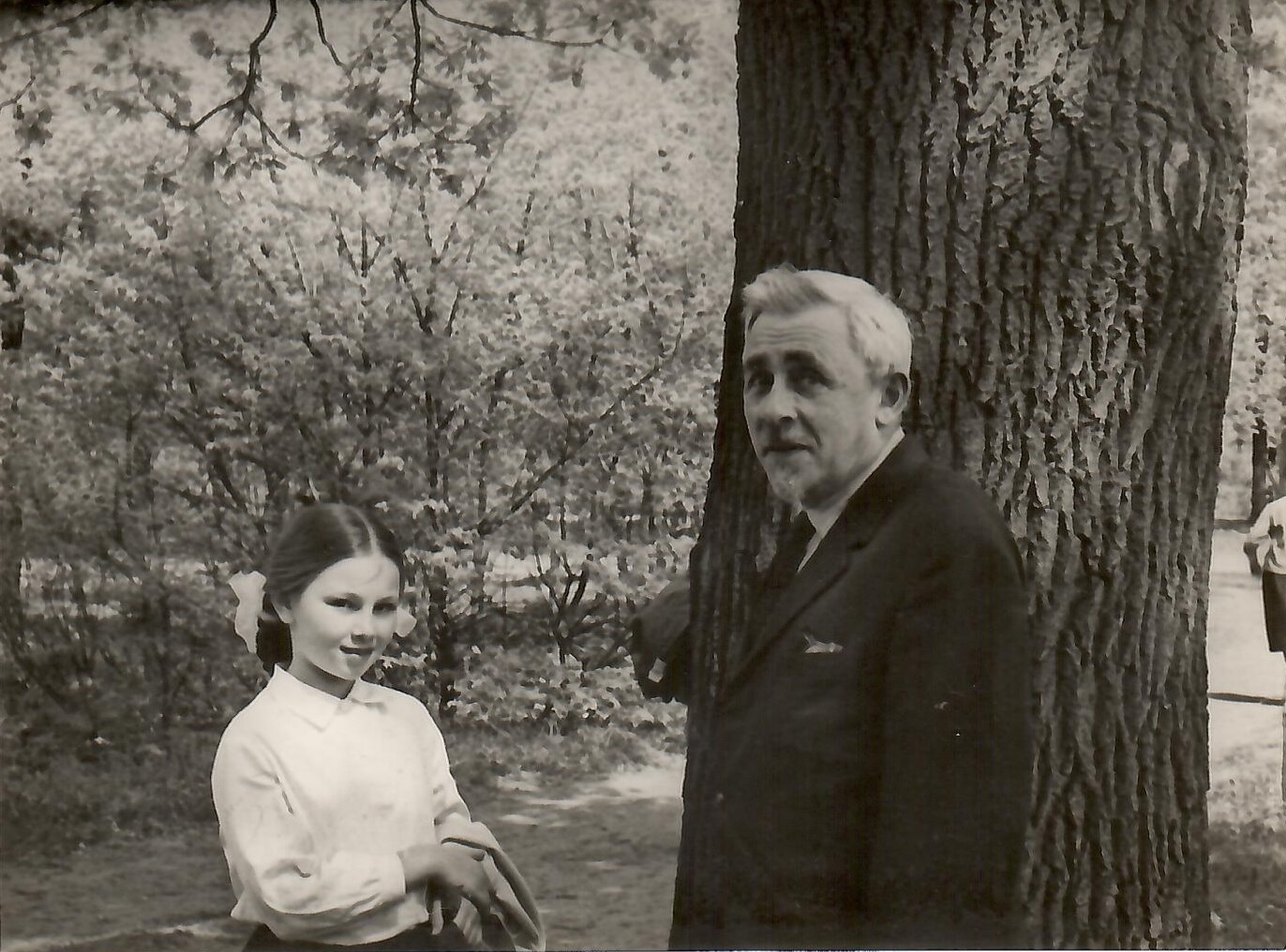
With his granddaughter Tatyana.
They got married in 1946 in Moscow, and the following year their son Dmytro was born. Halyna was an amazing woman: vibrant, beautiful, with a wonderful sense of humor. She worked for many years as a professor at the Department of Mineralogy and Petrography of Kharkiv University. They lived a very happy life together.
I was born in 1958 and constantly lived with my parents in my grandfather's apartment. It was a large double apartment, where initially eight of us lived. There was not only a grandiose mathematical library, but also a wonderful collection of fiction. Interestingly, the books were arranged not alphabetically, but according to some logic of their own.
Grandfather was keenly interested in my studies. He himself always woke up very early and worked a lot. Despite worldwide recognition, he never traveled abroad, and generally traveled little – mostly to Moscow or Kyiv.
Naum Ilyich's works continued to be published after his death. Literally a month before his passing, in May 1980, he completed the manuscript «Variational Calculus» (published in 1981). In 1984, «Lectures on Integral Transforms» saw the light of day.
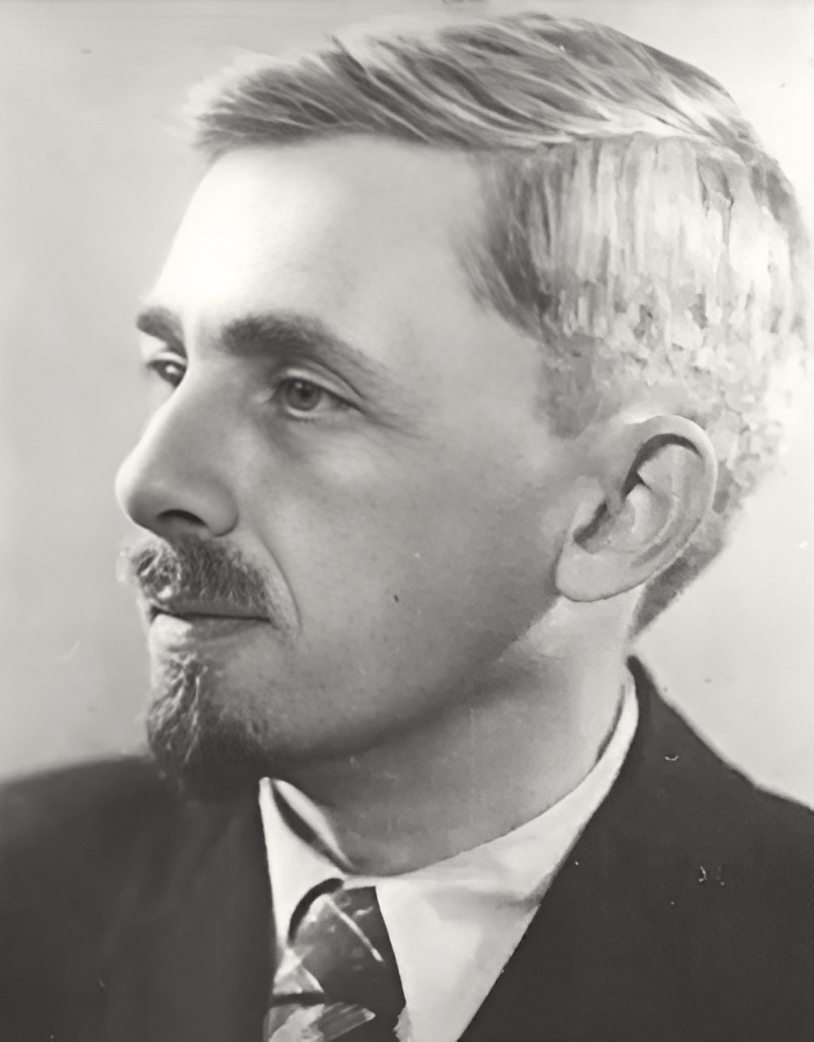
A special story is connected with the two-volume «Selected Works». A huge amount of work on it was done by his sons – Alik and Dima. My father woke up every day at five in the morning and before work translated his grandfather's articles and dissertation from German, and Dmytro checked these translations as a mathematician. The scientific editor was Yuriy Ilyich Lyubich. The first volume was published in 2001 – with the very photo on the cover that you see.
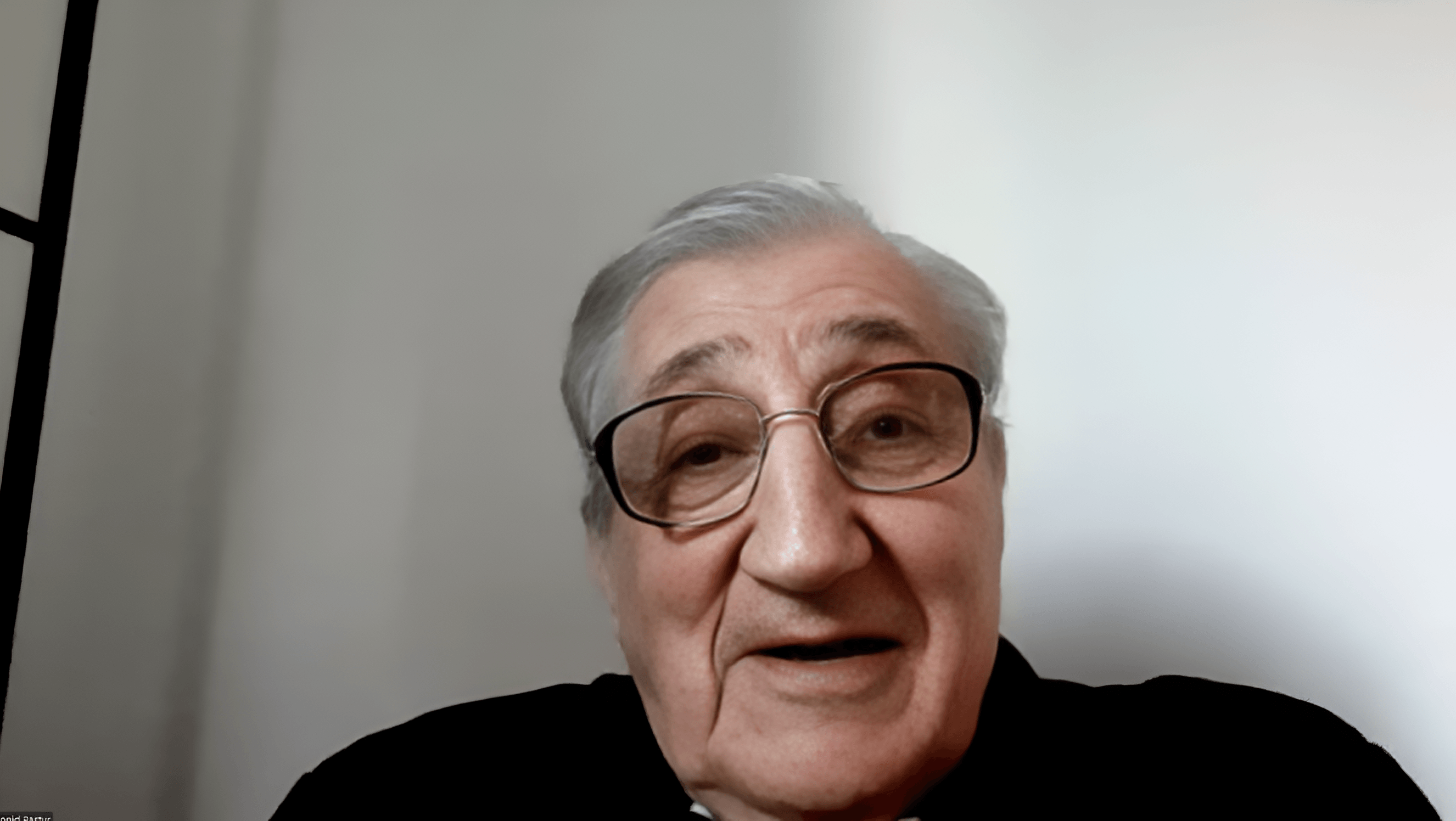
Academician of the National Academy of Sciences of Ukraine Leonid Pastur
Chief Researcher of the Mathematical Department of B.I. Verkin ILTPE of the National Academy of Sciences of Ukraine, Academician of the National Academy of Sciences of Ukraine Leonid Andriyovych Pastur recalls Naum Ilyich:
«For my generation, Naum Ilyich Akhiezer was already a true legend. I listened to his lectures at the Polytechnic Institute, and later began working at ILTPE, where he headed a department. Although we did not have very close personal relationships, I would like to emphasize two defining features of his personality and activity.
First: Naum Ilyich was the informal head and elder of the Kharkiv Mathematical School. The school itself was formed in the 19th century and is associated with the names of Oleksandr Lyapunov, Volodymyr Steklov, and Serhiy Bernstein. However, its rapid development in the post-war years is largely due to Naum Ilyich.
He was not an authoritarian leader – on the contrary, he was an extremely intelligent person with a subtle sense of humor. But he had his own, extremely effective methods. For example, Akhiezer played a decisive role in convincing the outstanding geometer Oleksiy Pogorelov to move from Moscow to Kharkiv in 1947. It was a very delicate diplomatic matter, and Naum Ilyich handled it brilliantly. Thanks to his efforts, mathematics in Kharkiv was maintained at the highest level – from the founding of the 27th Physics and Mathematics School to the leadership of the Institute of Mathematics.
Second: my colleagues and I called him a «mathematical writer». His ten monographs are already weighty proof, but it's not just about quantity. Books can be written in different ways. Naum Ilyich possessed a unique gift for formulation.
I recall an episode told to me by my colleague Volodymyr Hurariy. He once complained to Naum Ilyich that he had a good theorem but couldn't formulate it elegantly – it came out somewhat «clumsy». Akhiezer listened and in a second proposed a formulation: precise, concise, and truly beautiful. This was his talent as a «writer» – he saw the inner harmony of mathematical thought and knew how to give it a perfect form. His book «The Classical Moment Problem», which I read with delight, is the best confirmation of this.».

Academician of the National Academy of Sciences of Ukraine Yevhen Khruslov
Memories of the outstanding scientist were shared by the Chief Researcher of the Mathematical Department of B.I. Verkin ILTPE of the National Academy of Sciences of Ukraine, Academician of the National Academy of Sciences of Ukraine Yevhen Yakovych Khruslov:
«Naum Ilyich Akhiezer was an outstanding educator. His lectures impressed with their originality and sophistication. It is said that he delivered them with extraordinary artistry, fully dedicating himself to the process while simultaneously showing immense attention to his listeners. I was not fortunate enough to attend his lectures, but I repeatedly heard his reports at meetings of the Kharkiv Mathematical Society.
We got to know each other better when Naum Ilyich agreed to be an opponent for my PhD dissertation. Academician Volodymyr Oleksandrovych Marchenko asked him to do so. As Marchenko recalled, Naum Ilyich wanted to delve deeper into the problem of homogenization of boundary value problems in fine-grained domains, to which my work was dedicated. At that time, this direction was just beginning to actively develop in France, in the school of Jacques-Louis Lions.
Naum Ilyich studied the dissertation text very carefully. Since some parts of my work were not presented entirely successfully, he invited me for a discussion. It was during this discussion that he drew my attention to a little-known work by Norbert Wiener. The problem considered there was very close to homogenization problems in its formulation. Wiener was then working at the Massachusetts Institute of Technology, was fascinated by cybernetics, and was probably contemplating the structure of the first computing machines.
These conversations with Naum Ilyich were a real revelation for me. I realized how highly erudite he was, deeply knowledgeable about world publications not only in mathematics but also in physics. His ability to see connections between modern problems and classical works of the past was phenomenal».".
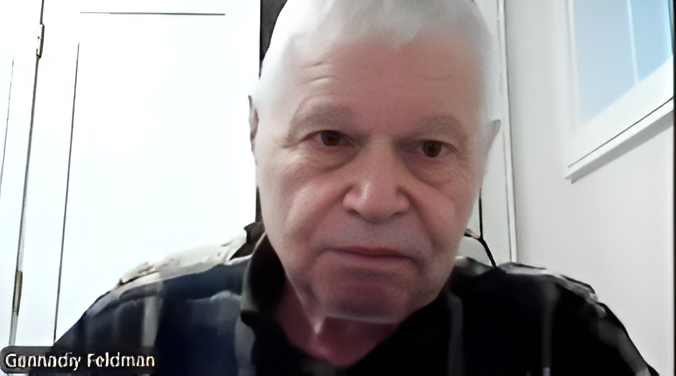
Corresponding Member of the NAS of Ukraine Hennadiy Feldman
How Naum Akhiezer was imprinted in his memory was also told by the Deputy Director for Scientific Work of B.I. Verkin ILTPE of the NAS of Ukraine – Head of the Mathematical Department of this Institute, Corresponding Member of the NAS of Ukraine Hennadiy Mykhailovych Feldman:
«First of all, I want to supplement Yevhen Yakovych's words about the International Congress of Mathematicians in Edinburgh (1958). The Soviet Union was then one of the leading scientific centers, but only 22 mathematicians from around the world were invited to deliver a plenary hour-long report. From the USSR, there were five: Oleksandr Aleksandrov, Mykola Boholiubov, Lev Pontryagin, Izrail Gelfand, and Naum Akhiezer. This list of names best illustrates the global scale of Naum Ilyich's figure.
For me, Naum Ilyich was a true «celestial being». I belonged to the first intake of the 27th Physics and Mathematics School founded by him. I remember how, after entering the Faculty of Mechanics and Mathematics, I asked him: «What should I pay special attention to in my studies?». To my surprise, he named not analysis or differential equations, but linear algebra.
Naum Ilyich played a decisive role in my destiny. I was an exemplary excellent student, headed the student scientific society, and had publications. However, due to a conflict with the party bureau during the previous graduation placement, I was denied a recommendation for postgraduate studies. Moreover, I was explicitly told: the most I could hope for was a job in a rural school.
Depressed, I accidentally met Naum Ilyich in the corridor. He asked why I was so gloomy, and I told him everything. I still remember his words: «It's nothing terrible. I also worked in a school in my time. The main thing is to continue doing mathematics; the rest depends only on you». He didn't say a single condemning word about the dean's office or the party committee; he only encouraged me.
However, I later learned that Naum Ilyich, having colossal authority, intervened in the situation. He arranged for me to receive a recommendation for postgraduate studies (albeit on the condition that I would not apply to the university) and a placement in a design institute in Kharkiv. Thanks to this meeting and his intercession, I was able to enter postgraduate studies at ILTPE in 1970, where I work to this day. It's hard to even imagine how my life would have turned out without Naum Ilyich's help.
Hennadiy Mykhailovych also recalled that at Naum Akhiezer's funeral in 1980, which almost all of mathematical Kharkiv attended, one of the attendees, not a mathematician, asked one of the mathematicians who Naum Ilyich's students were. In response, the mathematician simply gestured to the hundreds of scientists present and said: «Here they all are, Naum Ilyich's students». And it was indeed so. Akhiezer was a mentor not for a separate group, but for the entire Kharkiv mathematical school».".
Leading Researcher of the Department of Function Theory at B.I. Verkin ILTPE of the NAS of Ukraine, Doctor of Physical and Mathematical Sciences, Professor Volodymyr Oleksiyovych Zolotaryov recalled the following:
«My relationship with Naum Illich began in 1970 at the Department of Mathematical Physics of Kharkiv State University [now – V.N. Karazin Kharkiv National University], where he was the head. I was then a third-year student.
My story largely echoes Gennadiy Mykhailovych's recollections. At the graduation placement in 1973, Naum Illich personally stood up and stated that the department planned to keep me for postgraduate studies. However, the then-rector Volodymyr Khotkevych insisted: first, the state order for personnel distribution must be fulfilled, and only then should one think about science. Naum Illich asked me to go out into the corridor and wait. When I was called back, there were almost no free places left. There was only one vacancy in a research institute. I looked at Naum Illich in confusion, and he calmly nodded: «Sign it.» Already in the corridor, he added: «They will give you a release there.» Thanks to his tactic, I was able to enter postgraduate studies at my home department.
Then our joint work began. Naum Illich lectured on variational calculus, and he entrusted me with conducting practical classes. We communicated weekly. It was fundamental for him that mathematical problems had physical meaning or practical significance: be it the principle of least action or extremal problems of geometry. He personally selected exercises from the classic problem books of Mykola Maksymovych Gyunter and Rodion Osiyovych Kuzmin, demanding from students not just calculations, but an understanding of the essence.
Naum Illich always repeated a phrase that sounds particularly relevant today in the context of discussions about the Baker–Akhiezer function: «If mathematics is beautiful and good, it will certainly find its application.» He believed in the intrinsic value of aesthetics in science, and time confirmed his correctness: the objects he studied purely theoretically became the foundation for modern mathematical physics.».
Recalls Associate Professor of the Department of Higher Mathematics and Physics of the Faculty of Transport Process Management of the Ukrainian State University of Railway Transport (Kharkiv), Candidate of Physical and Mathematical Sciences Volodymyr Ivanovych Khrabustovskyi:
«I studied at school No. 27, in the same class as Naum Illich's son – Dmytro. Perhaps that is why Naum Illich paid special attention to our class. Although my family was purely humanitarian and I initially did not fully realize the scale of Akhiezer's figure, his lessons and lectures within the school walls were imprinted in my memory for life.
I especially remember his lecture on Euler's theorem for polyhedra. For demonstration, he brought a paper model of a dodecahedron. Later I asked Dmytro: «Did your father ask you to glue this model?» To my surprise, Dima replied: «No, my father prepared for the lecture in the eleventh grade himself and made this polyhedron with his own hands.» This episode best illustrates the responsibility and love with which Naum Illich approached teaching, even at the school level.
Subsequently, as a student of the Department of Mathematical Physics, I attended almost all of his special courses – from «The Problem of Moments» and «Elliptic Functions» to a series of lectures on generalized functions and hydrodynamics. Even after becoming a postgraduate student at FTINT, I continued to attend his classes. Each of Naum Illich's lectures was a true artistic performance. I remember how, due to certain circumstances, he could not deliver the last lectures of the «Integral Transforms» course and gave me his notes. I meticulously copied his notes on convolution-type equations – they were impeccably structured.
Naum Illich never behaved like a «boss,» although his authority was undeniable. He was an extremely polite and noble person. It was thanks to him that I started working with Fedor Semenovych Rofe-Beketov. Even in photographs, it is clear that he was not just a great, but also an internally beautiful, bright person. The memory of him will forever remain with me.».
Next, Professor Roald Mykhailovych Trygub:
«Although I did not study in Kharkiv, but received my education and completed postgraduate studies in Dnipro, it was Kharkiv that became the place of my scientific defense. This was a unique case: my opponents were Naum Ilyich Akhiezer, Boris Yakovlevich Levin, and Yakov Lazarovich Geronimus. Akhiezer's feedback as an opponent became a lifelong model for me – I still reread it every time I act as an opponent myself. This is a true standard of scientific depth and correctness.".
«In 1967, when I was working in Sumy, Naum Ilyich called me. At that time, large review articles were being prepared for the 50th anniversary of Soviet power. Akhiezer was commissioned to review achievements in approximation theory over the last decade. To my great surprise, he offered me: »I invite you to be not just an assistant, but a full co-author." For me, then a young scientist, this was incredible recognition. Unfortunately, due to the ideological censorship of that time (the surnames of many authors of scientific works were not liked by the then party curators of science), this review was never published in its original form, but Naum Ilyich's gesture itself remained in my memory forever.".
«Later, when I was already working at Donetsk University, I congratulated Naum Ilyich on his 80th birthday with a telegram. I wrote that he had opened the way for me into great mathematics. Although I simply signed as »Donetsk mathematician," he somehow miraculously immediately guessed who it was and sent a reply with warm thanks.".
»Naum Akhiezer was for me not just a great scientist, but a person who set the moral standard in our profession. Having worked for 45 years in Donetsk, I always felt his invisible influence and support.".
Here's what a well-known scientist, who for many years headed the Department of Higher Mathematics at the Kharkiv Automobile and Road Institute, Doctor of Physical and Mathematical Sciences, Professor, said about Naum Ilyich Yakov Isakovich Zhitomirsky:
«I want to add a few words about how Naum Ilyich – may his memory be bright – sincerely helped young mathematicians in their development.".
In 1960, after graduating from postgraduate studies at MSU [Moscow State University] and defending my candidate's dissertation, my wife Valentina Mikhailovna Borok and I dreamed of returning to our native Kyiv. We were both born there, graduated with honors from the Faculty of Mechanics and Mathematics of Kyiv University, but in those years it was almost impossible for us to get a job in the capital due to the antisemitism that prevailed there.
Our scientific advisor, Professor Georgy Evgenievich Shilov, approached Naum Ilyich with a request to help us with employment in Kharkiv. Thanks to the help of Akhiezer and Professor Gershon Ikhelevich Drinfeld, Valentina Mikhailovna was immediately accepted into the Department of Analysis at KhSU [Kharkiv State University]. I, however, did not manage to get into the university then, and I began my career as an associate professor at the Kharkiv Automobile and Road Institute.
Naum Ilyich did not give up trying to transfer me to the university. He even managed to arrange with the then vice-rector, Professor Khotkevich, for a special competition for the position of associate professor in 1963. However, the system proved stronger: when I came to submit documents with a positive reference, I was dryly informed that the competition had been canceled without explanation.
Despite these setbacks, Naum Ilyich continued to support me scientifically. When I brought him my doctoral dissertation a few years later, we had a long and deep conversation. He was extremely pleased with the direction of my research – the theory of functions satisfying differential equations. It was he who presented my work for defense at FTINT, where I successfully defended it in 1967.
Naum Ilyich was an amazing, charismatic person. For us, young scientists, it was not just pleasant, but extremely honorable to communicate with him. The memory of his kindness and professional nobility will forever remain in the hearts of many of us.».
At the end of the meeting, academician of the NAS of Ukraine Leonid Pastur and corresponding member of the NAS of Ukraine Gennadiy Feldman recalled the history of the creation of the landmark two-volume work «Selected Works on Function Theory and Mathematical Physics». This publication, dedicated to the 100th anniversary of Naum Akhiezer, was the result of the dedicated volunteer work of his family and students. The two-volume work was based on little-known early articles by Akhiezer, which his sons, Oleksandr and Dmytro, personally translated from German. Yuriy Lyubich became the scientific editor of the project. The first volume was published in 2001, and its cover was adorned with a famous photo of the scientist. Later, the second volume was also printed. The books were published in Kharkiv through the efforts of a publishing firm led by Akhiezer's student. Despite the fact that this publication existed for a long time only in paper form and was accessible to a narrow circle of specialists, it fulfilled an invaluable mission – it preserved for world science unique works that were previously considered virtually lost to the general public.
A kind of final touch to the scientist's portrait were the memoirs of a former employee of the Function Theory Department of B.I. Verkin ILTPE of the NAS of Ukraine, Candidate of Physical and Mathematical Sciences Oleksandr Myronovych Rusakovskyi, who noted the profound influence of Naum Illich's personality even on those who did not communicate with him personally. Thanks to a long-standing friendship with Tetiana Akhiezer, he had the rare opportunity to use the mathematician's home library, reading the original works of Shakespeare, Shelley, and Byron. This allowed him to directly experience the extraordinary cultural layer in which exact sciences and world classics harmoniously coexisted. The speaker was particularly struck by an incident at a meeting of the Kharkiv Mathematical Society in 1980, where Naum Illich, demonstrating amazing foresight and calm, began his report with words that this presentation would be his last. In 2019, this report was published in the «Journal of Mathematical Physics, Analysis, Geometry».
Closing the meeting of the anniversary session of the General Assembly of the Department of Mathematics of the NAS of Ukraine, which was held jointly with the Kharkiv Mathematical Society, the Academician-Secretary of the Department of Mathematics of the NAS of Ukraine, Academician Oleksandr Mykolaiovych Tymokha thanked his colleagues for their active participation and memories. «Today we had the opportunity to once again ascertain what an extraordinary personality Naum Illich Akhiezer was. He left Ukraine and the world a colossal scientific legacy, but his most valuable achievement is the Kharkiv Mathematical School. This is a living intellectual environment that continues to develop today. Our common task is to preserve this legacy!» he emphasized in his concluding remarks.

According to the Department of Mathematics of the NAS of Ukraine
and the B.I. Verkin Institute for Low Temperature Physics and Engineering (ILTPE) of the NAS of Ukraine
Photo – from the family archive of the Akhiezer family